Medical ministry

We have discovered a new aspect of our ministry here.  It has come to us unexpectedly, through different circumstances.

We have ourselves made several trips to the doctor here – always a bit scary in a foreign country because of unknown standards, and unknown costs.  However, there seems to be quality care available here for a low cost.   (For example, you could go in  with an infection, see a doctor, and leave with a prescription for less than ten dollars.)

There is also some kind of health insurance that everyone here is supposed to have.  It seems, though, that there are some complicated rules regarding how to use it.  (Surprise, surprise.)

So we have been baffled when people with medical issues that obviously merit professional attention put off going to the hospital.  (Or simply refuse to go.)  As we tend to do when confused by something, we have persisted in asking questions:  Is it because you don’t think your condition is bad enough to see a doctor?  Is it because you think that going to the doctor means you don’t have faith to be healed?  Is it because you are afraid of doctors?  Is it because you don’t have the money to go?

Bingo.  Almost every time, people put off going to the doctor because of cost.

  • A young woman who we discover has been weeping instead of sleeping at night for several weeks because of the pain in her chest.
  • Our DTS translator who has collapsed on several occasions for unknown reasons (and it was happening more and more frequently).
  • A young woman who fell HARD onto cement, landing on her head and back.

So as we ask questions about why people aren’t going to the doctor, and recieve answers that it is merely because they can’t afford it, we have thought,   “We can meet this need. Surely we have 30 or 40 bucks that we can carve out of our monthly budget to help our friends get medical care?!”

Its not a “ministry” we planned to have, but we are privileged to do our bit.

Discipleship Training School

I (Amanda) love Discipleship Training School (DTS) because it is designed to be a greenhouse environment with many classroom hours learning biblical concepts BUT the focus is really on healing, character change, growth, serving, and helping others know God. Its hard to staff DTS’s because they require so much time and emotional energy. I have staffed 8 DTS’s in three different locations prior to this one.  (In terms of official hours, this doesn’t put me at the 10,000 practice hours required to be an expert at something, but I’m getting close.)

This is the first DTS with both a totally new team and new environment. It has required a lot of adapting, evaluation, flexibility, creativity, and work.

It has made me think a lot of the first DTS I staffed. At the end of that school it seemed like I was a total failure. Yet, I had done my best every day (ok, most days), and at the end there were very few things I could concretely identify as mistakes. I felt like I had done a very poor job, but I couldn’t even learn from it. What a waste.

With a few years of perspective, I could identify a few things that had contributed to this: a main one was that I wasn’t as good at asking questions of the right people – but also at this time there was a shortage of people to ask, so I often felt like I had to figure it out myself. My co-leader and I were both on a steep learning curve, and though we wanted to work together and be kind to each other, we didn’t always know how. (We did come away good friends, though). We agonized over sending a student home from outreach. (Again, looking back, it seems an obvious choice, but at the time the situation seemed complicated, impossible, and cruel.) I had been taught that evaluation is an important tool, so I agonized as I tried to identify how I had failed, but I without any success.

But staffing this school, I am recognizing that it wasn’t so much that I made big mistakes. However, my skills, character, and confidence needed to develop. I’ve gotten better at some practical skills like communicating and classroom management. But more importantly, I think, I treat people differently: more kindly, more patiently, more graciously, and more wisely.

I’m sure any of you who’ve ever spent much time with me don’t imagine that confidence has ever been a huge issue for me, but my confidence has changed and grown: Now I am confident that I will make mistakes (and thats OK). I am confident that no matter how hard I try, other people still might get hurt and will definitely make bad decisions. I am confident that God will work with me even when I make mistakes, and that it is more important to care for people than to be right. I’m confident enough to tell people when I don’t have answers.

I think I take the responsibility of leading more seriously than I ever have, yet it doesn’t weigh on me in the same way: I work hard to do what I know to do with the abilities I have, and the rest is out of my hands.

I ache when I think of some of the students and staff I was with those first few years: I would be so much better if I could work with them now: I would enjoy them so much more and be a MUCH better leader, teacher, and friend.

It makes me wonder how I will grow and change in the next 10 years (20? 30?). (I hope I continue to grow in kindness, graciousness, patience, etc.) In some ways I wish I could be that person now: but so much of how I have changed has been earned through experience: heartache, joy, failure, triumph, and of course, walking through life with others. I can’t have that instantly.

I wrote this before we got the information about our visas last week, and it has been an incredible difficult week, with obstacle after (ridiculous) obstacle, and we have been really close to packing it all in and coming home several times.  While  I wouldn’t wish for these challenges, it has been going through circumstances such as this one that have refined my character.

We’ll keep you posted when we know something.

@#%$*!!! – a small update

When we were planning to come here, we anticipated that many things would be difficult, but one of the things that should have been easy was getting visas.  However.  After 10 weeks of processing (should take 3 days), during which our base leaders had a meeting with one of the higher-ups at immigration (during which they were told that the visas would be put through, and misunderstandings were cleared up), and we recieved a personal visit from some of the people there (during which we were told we would have the work permit on the next business day), we finally got a call on Wednesday saying that our visas were ready.  We rejoiced, we celebrated!  Finally!

This has been a long month of not only trying to deal with our own visas, but trying to get our student visas, too.  One of our Rwandan students is having trouble getting a passport: her parents are dead/not in contact with her, so they cannot verify her identity by theirs.  And there is a discrepancy on her ID about her birthdate…  so they won’t give her a passport.  (One of many messes that continue to cause practical issues in a country torn apart by war.)  So this seemed like the first of several victories after a long struggle.

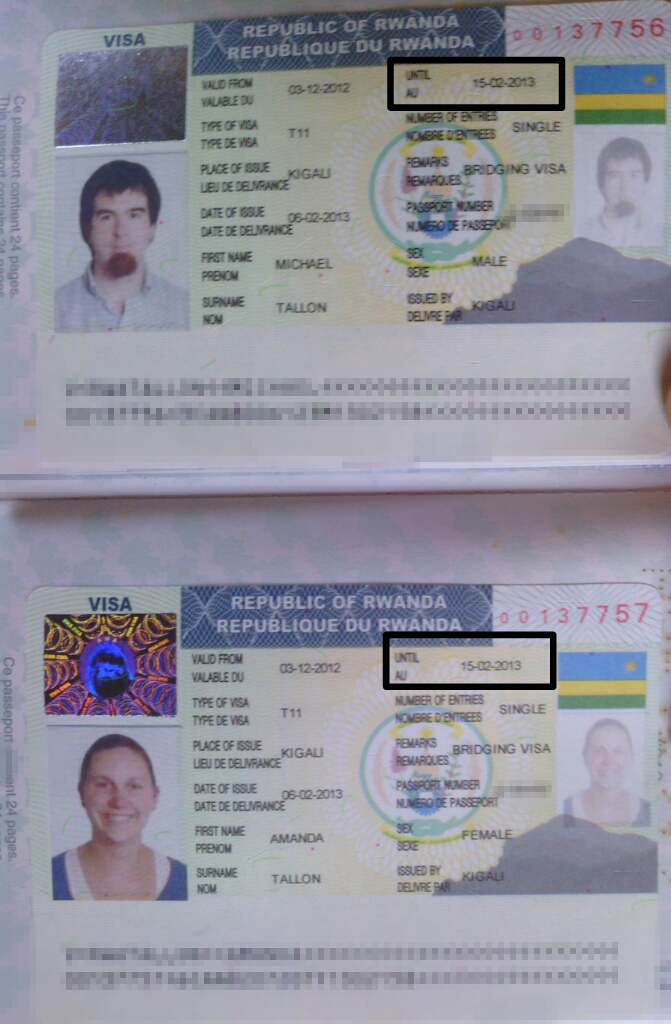
So it felt like I had been kicked in the head when I went to pick up our visas on Thursday and they looked like this:visa pictures-610477848

For those of you squinting to read the numbers in the box, the visas are valid until Feb. 15, 2013.  Meaning Friday.

So, after crying a lot, discussing, prayer, and encouragement from others, we decided not to just pack up and go home.  We are going to try again, we’re not sure how yet, but there are a couple of options that might work.  We’ll keep you updated when we know something.

Umuganda

This past weekend we took part in our first community development event called Umuganda (I could be spelling that incredibly wrong but it sounds like this – oo-moo-gan-da). Umuganda happens the last Saturday of every month and everyone that is able is expected to show up. The city of Kigali is broken up into areas and each area has a local leader (called an Umudugudu – say it out loud for fun – oo-moo-doo-goo-doo). Each area organizes a little differently. Rubirizi, our area, has a truck with a loud speaker that goes around and announces the details of the project a few days before it happens. The project begins around 8:30 am and continues until the particular project is accomplished (usually a couple hours). This is followed by a community meeting where the local leaders

challenge, encourage, and update the community on future projects, finances, security, and information from the government. This is also an opportunity for the local people to air any complaints, requests, or opinions about the community.

This particular Saturday, we took our fourteen students and four staff, grabbed some Koopakoopas (long blades used for slashing grass by hand) and headed for the bush. We live on what, a few years ago, was the edge of Kigali and so there’s still a lot of pasture land, farms, and even dairies in the area. We walked about three or four blocks and found ourselves in a densely brush-filled pasture with a path through the trees. The project was to clear out the brush, grass, and tree branches along the path so that tractors could get in and turn the path into a dirt road. When we arrived we found about 200 people gathered up and down the length of this kilometer of path, hacking away to clean it up.

Our crew got to work with much zeal! Maybe a little too much since most of the foreigners had never used the koopakoopas before and were swinging with wild

koopakoopa

koopakoopa: for an idea of its size, the handle is long enough to hold with two hands

abandon! This made me a little nervous because a small area packed with lots of people and just as many sharp blades seemed to me to be a recipe for disaster.

The locals, it turned out,

were pros at using the blades and clearing the scrub and so after working to counsel our guys to work more on their accuracy and a little less on their golf swing I became far more relaxed.

After only and hour and a half, the project was completed, having made a big enough space for tractors to fit. Everyone was called back up the hill to a plateau under a huge tree to start the community meeting.  The leader addressed many issues, encouraged the people for the large turnout, and welcomed us (the YWAM group) to our first Umuganda. We left before the meeting was over and headed back to the base to get cleaned up. Over all, I enjoyed the fellowship I found there and the spirit of community ownership that the people worked with. I met many new people who I expect to see around the shops and look forward to continuing to participate in future Umugandas.

Crisis Mode

It has been a little over 3 weeks with both of us running in crisis mode.  What I mean by this is that we have been running around, trying to get things done just barely before the deadline, and everything we are dealing with is very urgent and needs to be completed NOW.  It has felt like barely keeping afloat, not quite far enough ahead to deal with our responsibilities appropriately.

It has been exhausting.

This has been a result of a few things:  On January 7, we began a 5 month Discipleship Training School (DTS) with 14 students from 5 countries.  The first week of a DTS is always chaotic, with many details needing to be taken care of.  In this case we are working with a brand-new DTS leader, on a base where Mike and I are unfamiliar with many of the small day-to-day details [Where do I get mosquito nets from?  Where can we find mattresses for the beds that don’t smell like old pee?  How can I get cash to buy the fruit/cards for student welcome packs?  Do the students know that they will pay a fee for the pickup? The copier is broken – how can I print handbooks for students?  Is anyone going to finish painting these rooms before someone is supposed to live in them?  Do we have proper beds in each room for the students (ie, surely this mom shouldn’t have to sleep in the same bed as her 10-year-old son)?  I think you get the point.]

In addition, most of the base staff did not return from Christmas holidays until Jan. 7 (three days after students started to arrive).  This meant we had to solve many problems without proper information or tools.

AND, there have been some gaps in some of the staffing needs here.  There is a phenomenal woman named Margaret who was returning from a year-long sabbatical to step into this role.  She will be working with us to co-ordinate workduties, as well as with Mike in the kitchen.  There were many things waiting for her to deal with when she returned on the 7th, plus she was our DTS speaker for the week.  (This means she spent half of her days teaching.)

This week feels like we are starting to get our heads above water.  The students are starting to get into a routine.  Some of the things we have started to implement are starting to be understood (Mike isn’t meeting with work duty leaders every day).  We are starting to be able to work on non-urgent things (such as accounting for the $500 I was given the afternoon everyone left for holidays to buy food, electricity, etc for the base staff and visiting team that were here over the holidays).  We are even starting to be able to do things before the last second and plan ahead!

We are both feeling more hopeful, and are looking forward to the weeks to come.


Celebrating Christmas and the New Year!

OK: first of all, sorry for our absence. By the time we had holidays to write about, we were suddenly crazy busy. More on that in the next few weeks.

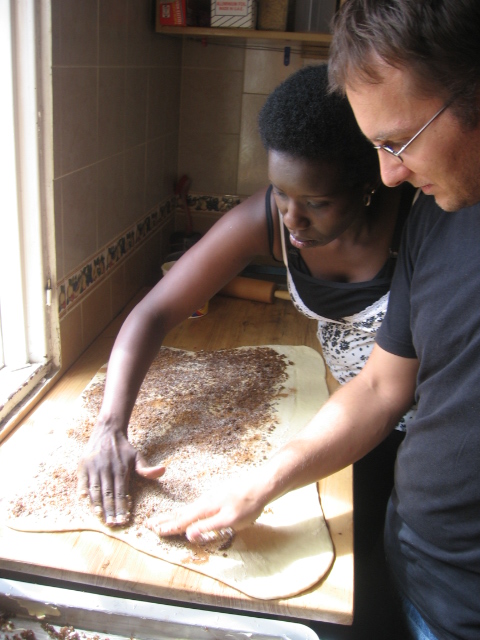
ArnoldWinnieCinn245795567Christmas seems so far behind us, but it is still a story to tell. On Christmas Eve we went to the house of a friend and baked cinnamon buns. It was a great treat and fun to spend time with friends!

ArnoldWinnieCinn2-1571532933

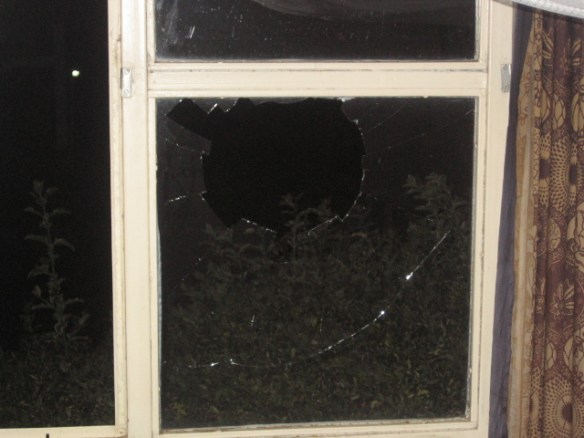
We returned to the base for the evening. There is an outreach team from Hawaii here, so we fired up the projector and watched a movie together. As we returned to our room in the dark, I walked barefoot into our bedroom to turn on our mosquito repeller. It took dead bird143347947me a moment to realize I was walking on broken glass. Then I saw a dark shape on the floor in the middle of the glass: Maybe someone threw something through our window? Nope. Dead pigeon. Ugh. (The curtains had even been closed!) So, as Christmas Eve progressed towards midnight, Mike was A-MAZING and cleaned most of the glass from our floor, our bed, our carpets, etc. Without a vacuum. And he dealt with the dead bird. I felt really awful, like someone had specifically invaded and wrecked our comfortable space. On Christmas Eve! IMG_8381IMG_8390

We got up Christmas morning feeling a little less invaded and made french toast! Our loose plan had been to go to a pool for the day, but it wasn’t a very nice day (only about 18 celcius 🙂 ), so we decided to try to wait for another day. We celebrated all together with MEAT for supper. Sadly, Mike was ill that night, so we didn’t go swimming the next day, and we delayed til the next day our private special meal to make us feel less homesick: perogies! YUM! They were wonderful.IMG_8399

By now you are surely getting the feeling that our celebrations were mostly about food. You are right.

New Years Eve we went back to our friends’ house (now it becomes important to know that he is Dutch). We made olliebollen, which I often make with my mom at New Years. YAY! We also reprised the bread dough and made a kind of braided pizza bread.

We are making some great friends, Godfrey & Hope. They live about 5 minutes away from the base. Godfrey runs the finance/administration office for YWAM. Hope runs a ministry with prostitutes. We are taking kinyarwanda lessons with Hope. They invited us to go out with them in the evening for a meal and bowling. We hopped on motos (its a good way to travel quickly without breaking the bank), and felt like a moto-gang as we went to the Chinese restaurant. We walked around back to the beautiful garden restaurant, and saw that the place was almost empty. “Do you have reservations?” they asked. We almost laughed, seeing all the empty tables. “We’re full,” they told us. hmmm… OK. So, we tried to regroup. None of us go out very much, so it was hard to come up with another place to go. We wondered, considered, and Hope volunteered that she knew of a Mexican place – we thought we could try it. So, we recruited 4 more motos, and our little moto gang travelled to the Mexican place. CLOSED.

We couldn’t believe it – strike 2. We dithered for a bit, didn’t want to go backwards, and finally decided to just go to the place we were planning to bowl at: apparently there was a small cafe there. Motos again. When we pulled up to the place, some guys were handing out flyers: for a New Year’s party, that apparently went until 4 am. Well, we weren’t really looking for a party, but no one else was there, so we decided that if we were at a place we could get food, we would stay. So then a mzungu came along and explained to us: “They are all busy getting ready for the party later.” Apparently, the party starts at 4 am. Its the after-party that everyone comes to when all the other parties close. Last year there were 1500 people!!!! We couldn’t believe that. “So… can we get some food anyway?” Sure (he told us, disappointed that we weren’t really excited abouyt partying until noon the next day). So by 10 pm, we finally got to eat. It wasn’t the amazing Chinese we had originally been planning on, but burgers were still a nice treat.

Then bowling! Theres not much in the way of recreation available, so this is very exciting. Godfrey, who had never bowled before, left us all in the dust.

And we took motos one more time on the way home!

All in all, our celebrations were pretty low key, a little disappointing, but we did get to hang out with some good friends and have a some rest before the big plunge. We had great communication from people at home and even got one of our Christmas packages!

Over one lunch

(I wrote this before Christmas, but didn’t get a chance to review it with Mike before now, so, I am posting it before a Christmas post.)

We were just asking some questions during lunch, and suddenly both of us ended up with new roles!  We were trying to find out more about how things work here, and what the plans are for certain responsibilities.  And, boom, Amanda is taking over communication and Mike is stepping into responsibility in the kitchen.  I’m sure none of you are surprised. 🙂

The communication for the base includes students, short-term volunteers, and teams that want to come.  I did this for a llittle while last time we were here, so I am hoping it will be easy to slide into this role.

As for the kitchen, there is a staff member who co-ordinates all the shopping, and a paid cook who cooks lunch and supper Mon-Fri.  Mike will be working mainly with these two to bring some variety and more efficiency to the menu.  (I am laughing as I write that, because variety and efficiency wouldn’t be the top two things I would say if I was naming his strengths – BUT when it comes to working in the kitchen, he definitely has a lot to offer in those areas!)  Right now, there is basically a weekly meal rotation: so Monday lunch is always the same, Thursday supper is always the same, etc.  There are so many tasty and fresh ingredients to use, so it seems a shame to always cook them in the same way!  Part of it is that we are used to much more variety than is usual here – so it is going to be a balancing act: trying to introduce a few new things/cooking things in different ways, while not changing too much, too fast.  (I know, I know, I’ve never before accused Mike of changing too fast – ha!)  People all over the world are very attached to their food, so it is a sensitive area. But Mike is really looking forward to working on this.

(We’ll post soon about our Christmas!)


Cultural Learning: Weddings

December is wedding season here in Rwanda.

One of the Rwandan staff members, Amiss, got married last Saturday!  We were really excited to go to his wedding, since he was someone we spent a lot of time with last year.  As well, he and his new wife (Marieth) will be taking part in the discipleship program Mike & I will be staffing starting in January.

A few weeks ago, another staff member, Odeth, asked me if I wanted to go to the meeting for Amiss’ wedding.  Um… I don’t know?  So I asked her, “Do I want to go to this meeting? What is it?  Will I be the goofy mzungu who doesn’t know what is going on?”  (I always try to find/identify a couple people who are trustworthy with these questions!  Otherwise, we end up going to church with someone, and after 8 hours of sitting in front of the way-too-loud blasting speaker, in the front seats, with a screaming preacher, and getting invited to join the choir for their missions trip to Congo next weekend, we finally have to say, “enough!  We have to go!” So Odeth is someone who is good at giving this kind of advice.)  She told me I should go, and she would translate for me.  So I went.  It was kind of fun – it was in a kind of restaurant/bar, and there were 5 or 6 other similar meetings going on.  Basically, the bride and groom have about 4 meetings each with their friends and family (there were 20 at the meeting I was at) to plan the wedding.  Together, they figure out the budget, offer to pay for certain items, decide together how they can do things differently, and volunteer services for certain things (ie, I’ll borrow my friend’s car and drive you to the reception).  No bridezillas here.  Meetings include a chairman, a treasurer, and a secretary to record minutes.  The person actually getting married doesn’t say much.  This was SO different from how things are done at home, but reminded me of our wedding: we had many meetings leading up to the event: taking minutes and delegating tasks.
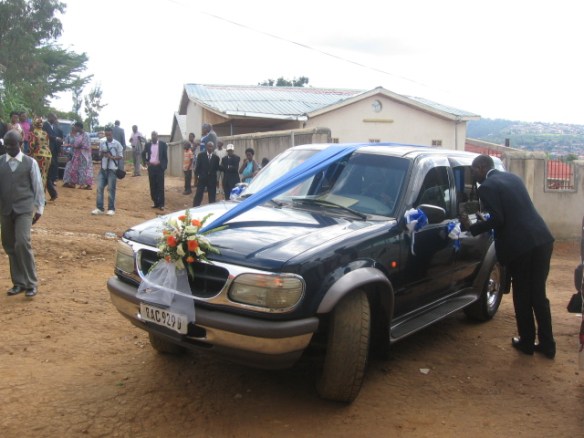
On Saturdays, you see vehicles like this all over the city.

On Saturdays, you see vehicles like this all over the city.

Weddings here are somewhat similar to weddings at home (ie, there is a wedding in a church, then photographs, then a reception usually including a meal).  However there are a few extra ceremonies that make for a very long day!  Traditionally, these ceremonies have taken place on different days, but now many young people are trying to do it all in one day.

First is the civil wedding, done in a government hall, often ahead of time.  I think this is the legal ceremony, but no one thinks the couple is married after this service.

Then comes the big day.  After getting up sometime around 4 am to get hair done, etc, the families and friends meet at the home of the bride’s parents/family for Introduction.  This is where the groom comes to “get” the bride, pay the dowry, things like that.  (We didn’t attend this part, but it took 3 hours, so I imagine that there were a lot of speeches, and play-bargaining about whether or not they could actually get married.)

After this ceremony, the couple goes to the Church Wedding.  (Unlike at home, everyone is not waiting for them to enter.  You show up whenever you want.  Our friend, for example, took us an hour after it had begun, so we missed the first half.)

exchanging rings

exchanging rings

Then photos – anyone who wants photos with the bride and groom goes with them.  When photos are finished, they come to the reception.
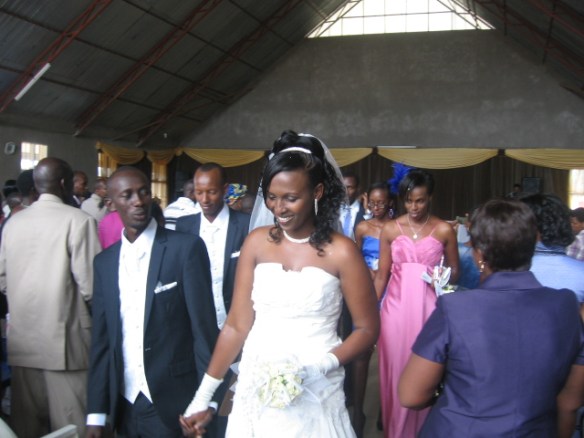
I felt uncomfortable running up/didn't recognize the appropriate time, so this was the best picture I got of the couple.

I felt uncomfortable running up/didn’t recognize the appropriate time, so this was the best picture I got of the couple.

Holding the glass of red “champagne” to the others mouth to drink made me nervous with all that white – but they didn’t spill!

To begin, someone opens “champagne” and they each hold it to the others’ mouth to drink.  (I was told that this happened about 8-10 times throughout the day!)

Speeches (different from our traditional speeches, though), soda for everyone, the guests presented gifts to the couple, (please understand I am abbreviating this a lot.  It was about 7pm by this time!), then the bride’s family asked permission to return home to spread the good news that their daughter is married.  Traditionally, the groom’s family makes excuses, says things like, “we have many beds, you can stay longer,” and the bride’s family is not allowed to leave until they are given permission.  Ha!  This family granted permission, though.

Traditionally, the bride would then spend several months with her in-laws, just sitting around the house, drinking tea, and generally being catered to.  I had several explanations for this, including: getting to know her place in the new family, being welcomed, having time to make a baby, and also waiting for her parents to save enough money to help the couple set up their own house (by selling maize they have grown, raising and selling a pig or cows, etc).  Then, her parents would come with all the things necessary for setting up a home: sugar, basins, soap, dishes, pots, etc, etc, and then they would have a ceremony where they would drink milk (representing prosperity) and then release their daughter to go out and work.  Relaxing at the in-laws’ is often skipped now, so, immediately after they went to a little side house (where they couple will be staying) and had this ceremony.  The couple then changed clothes and returned, and we all ate supper together.  There was more pouring of drinks, and the couple “feeding” them to each other, more speeches, and then, after a very long day for the couple, they were married!

Learning the traditions and participating in them is great for us to have more insight into the people and culture.

We are amazed again and again at how much time people take for everything; how tiring it can be!  However, we are learning to embrace it, and we are definitely looking forward to spending more time with this couple starting in January!

Ordinary Days

Well, this week has been remarkably ordinary. There have been a lot of small moments that helped remind us that most of the things we want to participate in/accomplish aren’t glamorous in the day-to-day, but the long term outcome is worth it.

We were greatly encouraged by a visitor from Tanzania who, after being here for a few days, remarked on how much it blessed her to just see us working: peeling bananas, doing dishes, etc.

Mainly, I (Amanda) worked on typing and editing a student handbook and helping organize a staff Christmas party; Mike planned a menu and cooked teriyaki stirfry for the party (that made him happy!). We also started kinyarwanda classes.

One of our goals is long-term discipleship: we want to see deep beliefs changed, so that actions change too. One of the things we encounter often is something I call “Christian fatalism.” What I mean is the belief that whatever happens is God’s will (and there is nothing you can do about it). This affects large and small decisions people make. There is something beautiful about being content in your circumstances, but this goes far beyond this to a kind of apathy in life direction and problem solving.

One situation arose in the last few weeks where several buildings were without power for 2 days. This can happen for a few basic reasons. 1.) The power is out, and will be until the power company restores it.  It happens.  2.) The cash you paid up front for the power has run out, and you need to pay more money. (You never know when it could happen. It can happen anytime.)   3.) The breaker has blown and needs to be reset. Now, if its the first one, there is nothing we can do. But if it is the second or third, it should be within our power to fix, right? Well, after investigating, the staff member supposedly responsible for these kinds of situations, doesn’t have a key to the room where the breakers/”cashPower” is… SO: after many conversations with various people, encouragements, waiting, then more conversations and encouragements, the particular staff member was lent a key to the room with permission to copy it!  I kept telling him: “You have to have the authority to carry out the responsibilty you’ve been given.”

And then… it was beautiful!

We had many guests here for a conference that same evening, and the power in most of the buildings went out. Someone was attempting investigation, so I said, “So-and-so has the ability to fix this!” A few seconds later, he went running by, and in about 10 minutes, power was restored! It was so amazing to see his work, conversations, and perseverance immediately rewarded because he was necessary, and capable of fixing the problem. Its a very small thing, and honestly partly selfish on my part (I dislike being without power for no good reason), but it was a small step in helping someone solve a specific problem, and gain confidence for problem solving in the future.

Tomorrow we are going to a wedding, we’ll tell you more about that soon.

Safari, so good!

This last week we were invited out to spend the day adventuring through Akagera National Park, one of the three national parks in Rwanda. The eight of us (five adults and three kids) packed into a jeep and headed out at about 5 in the morning so that we could make it there and back again in a single day.

The weather was beautiful, the park was welcoming, and though we were warned about the possibility of seeing little, we bore witness to a multitude of wild animals!

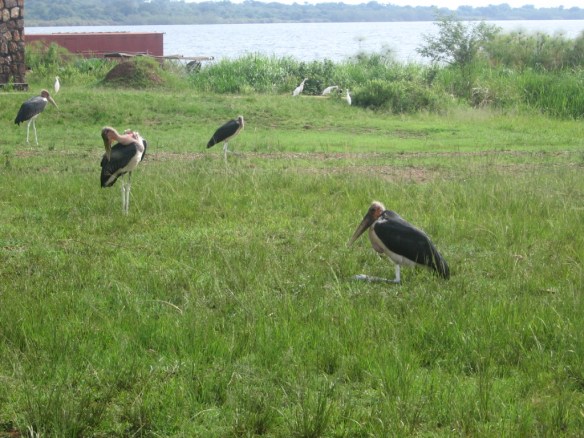
To start our excursion, we found several kinds of birds some of which looked like storks, crested cranes, some tiny yellow swallow-like ones that built igloo shaped nests in the trees, and what we thought were guinea fowl.

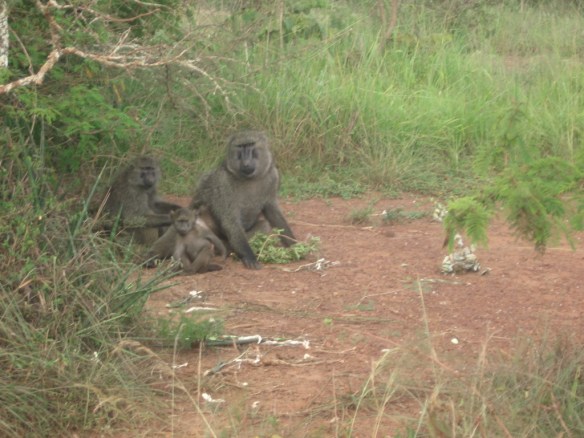
baboons together

 Over the course of the day we also spotted many different kinds of monkeys and baboons, which were often crossing the road or climbing nearby trees.

IMG_8246

hippopotamus’ (hippopotami??) were favourites for new and unusual sightings! We stopped at a lake and saw about half a dozen hippotpotamus’ near/on the shore. They backed into the water as we approached (in the jeep of course) and gave us a bit of a show what with yawning wide and snorting water at each other.

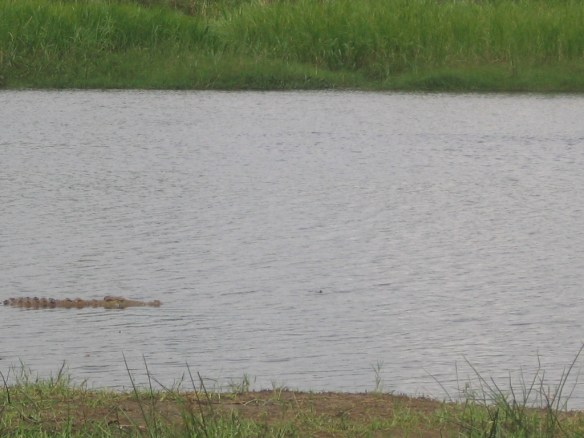
Swimming in the same lake as the hippos we saw some crocodiles. Pretty cool looking but also very evidently dangerous. giraffe sideways close

Drove into a basin where a herd (a tower?, a stretch?) of giraffes were chomping away on some of the trees. Unbelievable how vivid the dark splotches showed on their yellow/orange hides. And they really are as tall as they seem in children’s stories… I never would have expected to see so many giants in one place!!

IMG_8261

We drove through much forested area where we found herds of impala, zebras, deer, kudu, and, at the top of the list, elephants. We were driving down the trail and to our left we spotted a bull elephant maybe three jeep lengths away.

As we stopped to admire it, it became a little curious about us and then aggressive, as he began to stomp and move towards us. What we didn’t know was that on our right was the rest of his herd and as we had arrived in between them, the bull got mad. Since we decided it about time to continue on we scooted up the path until we discovered the herd of elephants enjoying dust baths in the trees. The bull continued to follow us up the dirt road toward his herd but was soon convinced we weren’t a threat and left us to our own devices.

The rain picked up as we neared the end of our adventures through the park and we were all glad for four-wheel drive. On our way out, as the clay-dense road turned slowly to heavy mud, we glimpsed a herd of zebra off in the trees. It was an incredible end to a day filled with the testament to God’s creative beauty and order.